

Les anciens employés de Nintendo ont mis en lumière pourquoi l'apparence de Kirby diffère entre les États-Unis et le Japon, offrant des informations sur les stratégies de localisation de Nintendo et les approches marketing pour le public occidental.
"Angry Kirby" a été obligé de faire appel à un public plus large
Nintendo a renommé Kirby pour plus d'appel dans l'Ouest
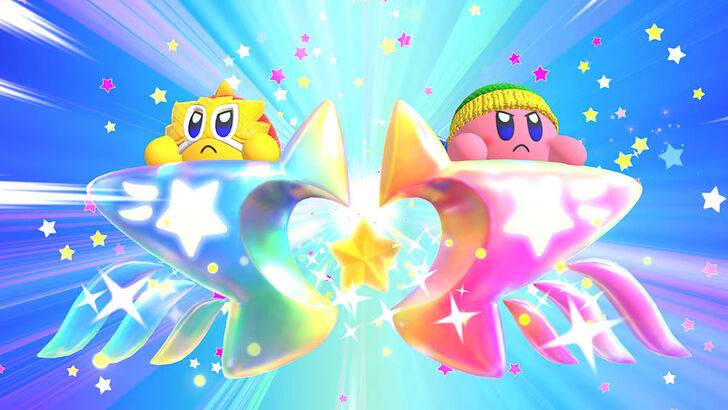
L'apparition plus féroce et plus stricte de Kirby sur les couvertures de jeux et les œuvres a été conçue pour résonner davantage avec le public américain, gagnant le surnom de "Angry Kirby" parmi les fans. Dans un 16 janvier 2025, une interview avec Polygon, l'ancien directeur de la localisation de Nintendo, Leslie Swan, a discuté de la raison d'être de la modification du look de Kirby en Occident.
Swan a précisé que l'intention n'était pas de mettre Kirby en colère mais de transmettre la détermination. Elle a noté: "Des personnages mignons et doux sont populaires parmi les gens de tous âges au Japon." Cependant, elle a ajouté: "Aux États-Unis, Tween et Teen Boys ont tendance à être attirés par des personnages plus difficiles."
KIRBY: Le directeur de Triple Deluxe Shinya Kumazaki, dans une interview de Gamespot 2014, a souligné que, même si Cute Kirby attire des joueurs au Japon, un "Kirby fort et dur qui lutte vraiment contre le public américain. Pourtant, il a reconnu que l'approche varie selon le titre, citant Kirby Super Star Ultra, qui présentait un Kirby dur sur nous et japonais Box Art. Kumazaki a souligné le désir de présenter le côté sérieux de Kirby à travers le gameplay, tout en reconnaissant que la gentillesse de Kirby reste un tirage important au Japon.
Annoncer Kirby comme "Super Tuff Pink Puff"

La stratégie marketing de Nintendo visait à élargir l'attrait de Kirby, en particulier aux garçons, en le considérant comme "Super Tuff Pink Puff" pour le jeu Nintendo DS 2008 Kirby Super Star Ultra. L'ancienne responsable des relations publiques de Nintendo of America, Krysta Yang, a expliqué que Nintendo avait cherché à perdre son image "Kiddie" au cours de son premier mandat. "Il y avait certainement une période de temps pour Nintendo, et même le jeu en général, d'avoir un facteur plus adulte / cool", a-t-elle déclaré. Yang a ajouté qu'être étiqueté «Kiddie» était préjudiciable au succès d'un jeu.
Nintendo a consciemment travaillé pour représenter Kirby comme plus difficile et souligner les éléments de combat de ses jeux, éloignant le personnage d'être perçu uniquement comme une icône pour enfants. Ces dernières années, comme on le voit dans le matériel promotionnel de Kirby et de la terre oubliée en 2022, l'objectif a davantage évolué vers le gameplay et les capacités plutôt que la personnalité de Kirby. Yang a noté: "Il y a eu une poussée continue pour faire de Kirby un personnage plus équilibré, mais il est vrai que la plupart des gens considèrent toujours Kirby comme mignon contre dur."
La localisation américaine de Nintendo pour Kirby
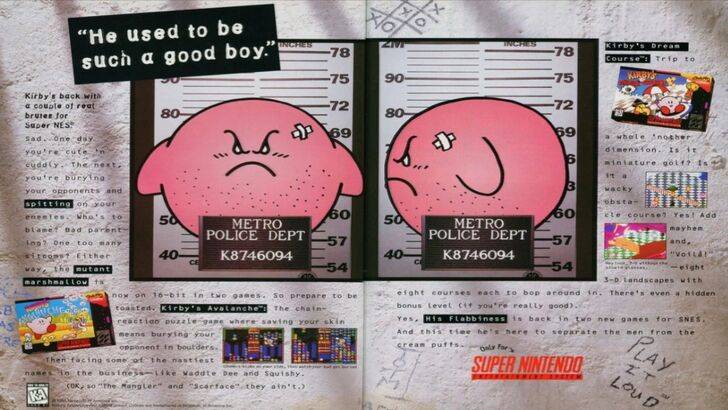
La divergence de la localisation de Kirby entre le Japon et les États-Unis a commencé avec une annonce imprimée notable de 1995 avec Kirby dans un mugshot dans le cadre de la campagne "Play It Loud" de Nintendo. Au fil des ans, US Box Art for Games comme Kirby: Nightmare in Dream Land (2002), Kirby Air Ride (2003) et Kirby: Squeak Squad (2006) ont représenté Kirby avec des sourcils tranchants et une expression sévère.
Au-delà des expressions faciales, Nintendo a fait d'autres ajustements pour faire appel au public occidental. Par exemple, la sortie de Gameboy en 1992 de Kirby's Dreamland a présenté Kirby avec un ton blanc fantomatique sur l'US Box Art, contrastant avec la teinte rose originale au Japon. Cela était dû à l'affichage monochrome du Gameboy, les joueurs ne voyant la couleur rose de Kirby uniquement avec la sortie NES 1993 de Kirby's Adventure. Swan a fait remarquer: "Un personnage rose gonflé pour les garçons qui essaie d'être cool n'allait tout simplement pas obtenir les ventes que tout le monde voulait."
Cela a conduit Nintendo of America à modifier les expressions faciales de Kirby sur US Box Art pour attirer un public plus large. Ces derniers temps, la publicité mondiale de Kirby est devenue plus uniforme, alternant entre les expressions sérieuses et joyeuses.
L'approche mondiale de Nintendo
Swan et Yang conviennent que Nintendo a adopté une perspective plus mondiale ces dernières années. Nintendo of America collabore désormais étroitement avec son bureau du Japon pour assurer des stratégies de marketing et de localisation cohérentes, s'éloignant des variations régionales comme celles observées dans l'art de Kirby's Box et la campagne "Play It Loud" de 1995.
Yang a expliqué que le passage au marketing mondial était une décision commerciale stratégique. "C'est bon et mauvais. Être mondial signifie la cohérence pour la marque dans toutes les régions, mais parfois il y a un mépris pour les différences régionales", a-t-elle déclaré. Elle a également exprimé sa préoccupation que cette approche pourrait entraîner "une commercialisation vraiment fade et sûre pour certains des produits de Nintendo".
Les localiseurs de jeux attribuent la tendance actuelle à la réduction de la localisation à la mondialisation plus large de l'industrie et à une familiarité accrue du public occidental avec la culture japonaise, y compris des jeux, des films, des mangas, des anime et d'autres médias.