
Maison >  Applications >  Outils >  Code Studio
Code Studio

Code Studio

Catégorie : OutilsVersion: 4.2.0

Taille:33.70MSystème d'exploitation : Android 5.1 or later

Promoteur:ALIF Technology

4.3
Télécharger
Description de l'application
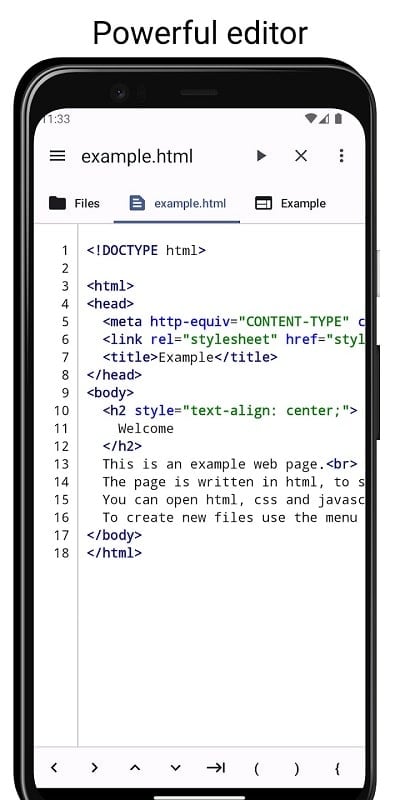
Expérimentez le codage comme jamais auparavant avec Code Studio ! Cet environnement de programmation mobile complet simplifie le codage dans plusieurs langages, notamment Scratch, Python et JavaScript. Des fonctionnalités clés telles que la complétion de code Java, un terminal intégré et un gestionnaire de fichiers intuitif rationalisent votre flux de travail. L'éditeur intelligent anticipe vos besoins, minimisant ainsi le temps et la complexité du codage. Gardez tous vos projets organisés et facilement accessibles dans l'application, éliminant ainsi le besoin de basculer entre plusieurs applications et systèmes de fichiers. Améliorez vos compétences en codage mobile avec Code Studio !

Code Studio Caractéristiques :

⭐ Codez de manière transparente dans Scratch, Python, JavaScript et bien plus encore dans une interface unique et conviviale.

⭐ Augmentez votre vitesse de codage avec des fonctionnalités intelligentes telles que la complétion de code Java.

⭐ Accédez aux fonctions essentielles d'Android et exécutez des commandes directement à l'aide du Terminal intégré.

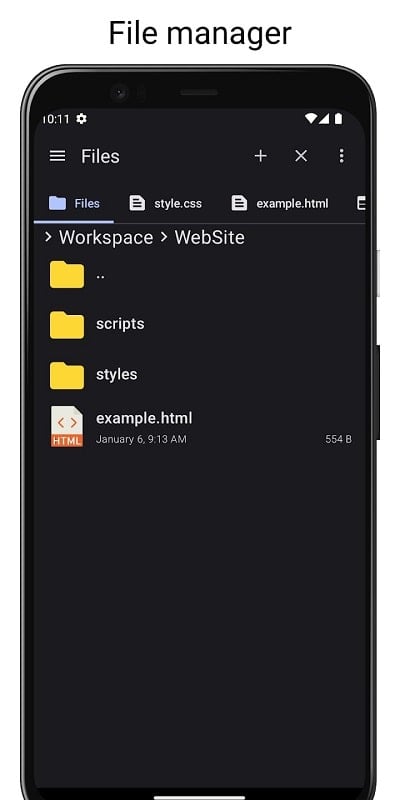
⭐ Gérez vos fichiers sans effort dans le gestionnaire de fichiers intuitif de l'application.

⭐ Bénéficiez de la saisie semi-automatique, du débogage en temps réel et des sauvegardes automatiques pour une expérience de codage fluide et efficace.

⭐ Ne craignez plus de perdre votre travail non sauvegardé grâce aux sauvegardes automatiques.

En bref :

Code Studio offre une expérience de codage mobile révolutionnaire, vous permettant de coder efficacement à tout moment et en tout lieu. Téléchargez maintenant et transformez votre flux de travail de programmation mobile.

Code Studio Capture d'écran 0
Code Studio Capture d'écran 1
Code Studio Capture d'écran 2
Code Studio Capture d'écran 3
Dernières nouvelles
It sounds like you're referencing a test or feature related to Cub8, possibly a rhythm-based game, music app, or a tool for assessing rhythmic precision in players. However, as of now, there is no widely known product or platform called

It sounds like you're referencing a test or feature related to Cub8, possibly a rhythm-based game, music app, or a tool for assessing rhythmic precision in players. However, as of now, there is no widely known product or platform called "Cub8" that's officially recognized in the gaming or music technology world. That said, here's a possible interpretation based on your phrase: "Cub8 Tests Players' Rhythm Precision" This could mean: Cub8 is a fictional or emerging rhythm game/app designed to assess how accurately players can match beats or timing. The system uses advanced audio processing or AI to analyze a player’s timing accuracy (e.g., hitting notes on beat, slight ahead/behind, microtiming variations). "Tests" implies a structured evaluation—like a rhythm IQ test, where performance is scored on metrics such as: Beat accuracy Consistency over time Response latency Groove and feel (subjective) If you're referring to a real product, beta test, or concept, please provide more context (e.g., platform, developer, release date), and I’d be happy to help explain or analyze it further. Alternatively, if you’re creating a game or testing tool called Cub8, here’s a quick idea for how such a rhythm precision test could work: 🎵 Cub8 Rhythm Precision Test (Concept) Objective: Measure how precisely a player can follow and anticipate rhythmic patterns. How it works: Player listens to a sequence of beats (e.g., 4/4 time signature). The app introduces subtle timing shifts (e.g., notes played 10ms early/late). Player must tap or respond in sync. System scores: Timing Deviation (ms): How far off their taps are from the ideal beat. Consistency: Standard deviation across multiple taps. Predictive Accuracy: Ability to anticipate future beats (e.g., in syncopated patterns). Score Output: "Rhythm IQ": 0–100 Feedback: "You’re a tight player!" / "Work on microtiming." Let me know if you’d like help building a rhythm test, naming a game, or analyzing performance metrics!

As of now, Major League Baseball's Major (commonly referred to as Major or Major: The Series) does not exist as a real television show, and there has been no official announcement regarding a Season 3 Revamp for such a series.
However, if you're referring to a fictional, fan-made, or hypothetical revamp of a show titled Major — possibly inspired by a real series like The Boys, The Peripheral, or even a sci-fi drama with a similar name — here’s a speculative and creative take on what a Season 3 Revamp might look like, assuming it’s a serialized drama with political intrigue, moral ambiguity, and high-stakes action:

🎬 Major – Season 3 Revamp:

As of now, Major League Baseball's Major (commonly referred to as Major or Major: The Series) does not exist as a real television show, and there has been no official announcement regarding a Season 3 Revamp for such a series. However, if you're referring to a fictional, fan-made, or hypothetical revamp of a show titled Major — possibly inspired by a real series like The Boys, The Peripheral, or even a sci-fi drama with a similar name — here’s a speculative and creative take on what a Season 3 Revamp might look like, assuming it’s a serialized drama with political intrigue, moral ambiguity, and high-stakes action: 🎬 Major – Season 3 Revamp: "Fracture" (Hypothetical) Theme: The Collapse of Truth After the explosive events of Season 2 — where the protagonist, Elias Vance, exposed a global conspiracy tied to a secret intelligence network known as "The Major" — Season 3 takes a darker, more surreal turn. The world is in chaos. Trust has eroded. Governments are crumbling. And the lines between hero and villain have vanished. 🔥 Key Changes in the Revamp: Narrative Shift: The season is non-linear, jumping between timelines: past (Elias as a young operative), present (his fugitive war), and a near-future vision of a surveillance-dominated society. The show adopts a dystopian neo-noir aesthetic, with heavy use of digital decay, deep fakes, and AI-manipulated media. New Characters: Kira Nox, a rogue AI entity who believes she is the true "Major" — not a person, but a system designed to "protect" humanity by eliminating free will. Dr. Aris Thorne, a former mentor turned enemy, who claims Elias was never the hero — he was the experiment. Plot Twist (Mid-Season): The entire series is revealed to be a simulation designed to test human morality under pressure. Elias awakens to a lab where he’s not a character — he’s a test subject. But the twist? He chose to believe he was real. Tone & Style: Influences from Black Mirror, Westworld, and The Manchurian Candidate. Episodes end with ambiguous or disturbing questions: "Who is in control? The machine, the man, or the myth?" Music & Sound: A haunting, electronic score by Oneohtrix Point Never, blending orchestral dread with glitch-hop rhythms. Fan Impact: The revamp polarizes fans: some praise its boldness and philosophical depth; others criticize its departure from the show’s original spy-thriller roots. 📣 Final Thought: If a Major Season 3 Revamp were to happen — whether real or imagined — it would likely be a bold reinvention, using the franchise’s mythos to explore modern anxieties about truth, identity, and technology. 💬 “In the end, the Major isn’t a person. It’s the lie we all keep believing to survive.” Let me know if you meant a real show (like The Walking Dead: Season 3, Suits: Season 3, or The Mandalorian: Season 3), or if you're building a fictional universe! I’d love to help expand it.